How now, mad wag! what a devil dost thou in Warwickshire?
Falstaff
to Prince Hal, 1 Henry IV.
In claiming positive identification of the native of Stratford-on-Avon,
Warwickshire, as the true and only "Mr. William Shakespeare,"
whose matchless comedies, histories and tragedies were issued in the
royal crown folio of 1623, running to nearly one thousand double-columned
pages, accepted authorities point with finality to the following circumstances:
1. Official documents of the town of Stratford and its environs record
the baptism, marriage clearances, parenthood, business activities, suits
at law and burial of one William Shakspere, Shaxpere, Shagspere, Shackespere
or Shaksper. He can be certified as the eldest son of John Shakspere,
etc., a butcher and wool-stapler of Stratford who also served as a burgess
and chamberlain of the borough but who, incidentally, was too illiterate
to sign his own name to his municipal accounts or legal documents. The
Warwickshire documentation covering the career of this Willm Shakspereas
he usually signed himself in halting and blotted charactersbegins
with his christening at the local church in April 1564, and ends with
his burial in the same edifice in April 1616.
2. A mural memorial to the author of the Shakespearean works was affixed
to the north wall of the chancel in Trinity Church, Stratford, at some
unrecorded date, presumably between the year 1616, when the citizen
of Stratford was buried, and the year 1623, when the First Folio was
published.
3. The introductory pages to the First Folio contain two references
to "Shakespeare" which unquestionably associate this name
with both the town of Stratford and the River Avon. These references
occur among the commendatory verses addressed to the Bard by Ben Jonson
and Leonard Digges.
Toward the end of his panegyric Jonson exclaims:
Sweet Swan of Avon! what a sight it were
To see thee in our waters yet appear,
And make those flights upon' the bankes of Thames,
That so did take Eliza and our James!
Leonard Digges begins his tribute thus:
Shake-speare, at length thy pious fellowes give
The world thy Workes: thy Workes, by which, out-live
Thy Tombe, thy name must when that stone is rent,
And Time dissolves thy Stratford Moniment,
Here we shall view thee still.
The notable gap in the Oxford-"Shake-speare" identification
up to this time has been occasioned by the inability of investigators
to resolve satisfactorily these Warwickshire associations which both
Leonard Digges and Ben Jonson give the Bard.
It has been held that even if a confusion of personalities had been
brought about by a deliberate conspiracy, such a claim by proponents
of the Earl of Oxford would merit serious consideration only when it
could be shown that the literary peer possessed credible prima facie
right to the title of "Sweet Swan of Avon" which Willm Shakspere
alone has enjoyed by virtue of geographical situation.
That Oxford did, indeed, have personal associations with the River
Avon, I shall now undertake to prove by contemporary documentation.
We find, in fact, that the first mention of the Earl as a full-fledged
public entertainer locates him directly upon the banks of the Avon in
Warwickshire.
On Sunday, August 18, 1572, he had accompanied the Queen and her Court
to Warwick Castle and on the evening of that day appears to have been
chiefly responsible for the staging of a realistic mimic battle which
attracted great crowds. An account of this affair is printed in The
Black Book of Warwick, edited by Thomas Kemp. 1
That Oxford was the moving spirit in the show is evident from the fact
that the Black Book chronicler mentions him more often than any other
of the noblemen who participated in this spectacular presentation. The
stage setting seems to foreshadow some of the battle scenes in 1
Henry VI:
. . . there was devised on the Temple ditch a fort, made of slender
timber covered with canvas. In this fort were appointed divers persons
to serve (as) soldiers; and therefore so many harnesses as might be
gotten within the town were had, wherewith men were armed and appointed
to show themselves; some others appointed to cast out fireworks, as
squibs and balls of fire. Against that fort was another castle-wise
prepared of like strength, whereof was governor the Earl of Oxford,
a lusty gentleman, with a lusty band of gentlemen. Between these
forts, or against them, were placed certain battering pieces, to the
number of twelve or fourteen, brought from London, and twelve fair
chambers, or mortar pieces, brought also from the Tower, at the charge
of the Earl of Warwick. These pieces and chambers were by trains fired,
and so made a great noise, as though it had been a sore assault; having
some intermission, in which time the Earl of Oxford and his soldiers
to the number of two hundred, with calivers and arquebusses, likewise
gave divers assaults; they in the fort shooting again, and casting
out divers fires, terrible to those who have not been in like experiences,
valiant to such as delighted therein, and indeed strange to them that
understood it not. For the wild fire falling into the river Avon
would for a time lie still, and then again rise and fly abroad, casting
forth many flashes and flames, whereat the Queen's Majesty took
great pleasure . . .
What would not the professional Stratfordians, give if they could present
a similar piece of attested local history, mentioning "Will. Shakspere,
gent." as the leading light of such a show?
Unfortunately for their case, no such documentation can be located,
however. Will never treated his fellow-townsmen to a single performance
of any of the many plays that have been credited to him.
The latter portions of the chronicle which I have put in italics seem
to have a very definite echo in Ben Jonson's verses which record Queen
Elizabeth's great pleasure in a genius that had first come to light
on the Avon.
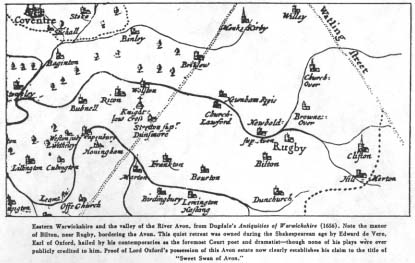
Nor is this all. The 17th Earl of Oxford had an estate in eastern Warwickshire,
overlooking the valley of the Avon, which can be proven to have been
retained by him after most of his other properties and known residences
had been sold.
The name of this favorite manor is Bilton Hall. And, strangely enough,
it is mentioned in the history of English literature as the well-loved
retreat of another famous writer of the 18th century. . . .
But the story of Lord Oxford's Avon Valley home is of sufficient importance
in the development of our argument to be told in orderly detail.
The ancient manor house is still standing amid its extensive gardens,
about a mile and a half from the center of the town of Rugby, just off
the road that connects with the lower Coventry highway. Although the
16th century boundaries of this property no longer exist, repetition
of the name Bilton on present day land-plats suggests that the estate
once included the actual banks of the winding Avon. Bilton Hall crowns
a ridge of high land that slopes away for a mile or so to the river
on the north and north-west. Some nineteen miles to the South-west is
located Stratford-on-Avon.
From the statements of Sir William Dugdale in his Antiquities of
Warwickshire (1656), 2
it appears that Bilton is one of the oldest residential seats in all
Warwickshire. Dugdale describes it as "the freehold of one Uluuinus
before the Norman invasion." In Domesday Book, the land
survey compiled at the direction of the Conqueror, the holding is "certified
to contain five hydes." As a "hyde" of land represented
one hundred and twenty acres, the entire property took in some six hundred
acres. All of these "except one virgate," (thirty acres),
continues Dugdale, "were then possesst by Roger de Montgomerie,
Earl of Arundell and Shrewsbury." At that time the property was
known as "Beauton."
Later, the Crafte and then the De Charnell families owned the manor,
until finally a daughter of Thomas de Charnell received the estate as
a marriage dower when she became the wife of a Trussell. For five generations
the Trussells are recorded as owners. Then, during the reign of Henry
VII, Elizabeth Trussell, heiress of Edward Trussell, married John de
Vere, 15th Earl of Oxford, and Bilton, among other valuable Trussell
properties, passed under the cognizances of the blue boar and the silver
star. So far as can be determined from the records at present available,
this beautiful estate is the only property ever owned in Warwickshire
by the Earls of Oxford during Tudor times.
Under the terms of the will of the 16th Earl of Oxford, who died in
August 1562, Bilton appears to have been one of the estates set aside
for the use or support of his widow, Margery Golding de Vere. It can
be identified among the "divers manors, &c., in the Counties
of Essex, Cambridge, Chester, Northampton, and Warwick," rentals
of which are designated as "the jointure of the late Countess of
Oxford" in the State Papers, Domestic, under date of February 1570,
3 following her demise in 1568.
The Countess of Oxford had made a rather hasty remarriage with one
Charles Tyrrell, an undistinguished but evidently handsome member of
the Queen's Bodyguard. She and her second husband lived in unostentatious
retirement. I can find no mention of their having appeared at Court,
following their alliance, and whether or not some of their time was
spent in the quiet isolation of the Warwickshire estate is a matter
of speculation.
But circumstances indicate persuasively that Edward de Vere himself
kept the place as a literary hideaway where he could carry on his creative
work without the interference of his father-in-law, Burghley, and other
distractions of Court and city life.
Most telling of these is the fact that he held on to Bilton "until
late in the reign of Elizabeth"after his fortunes had declined
to the point where he was forced to relinquish other ancestral properties
which had served him as personal residences.
During the early years of his married life with Anne Cecil, Lord Oxford's
recognized country seat was the manor of Wivenhoe on the Essex coast,
at the mouth of the Colne River. There are many mentions of Wivenhoe
in his correspondence and the Cecil family papers, covering this period.
The introductory letter to Thomas Bedingfield with which the Earl prefaces
his 1573 publication of Bedingfield's translation of Cardanus' Comforte,
bears a concluding sentence: "From my new country Muses of Wivenhoe
. . ."
But when he lived apart from his wife, records show that he turned
Wivenhoe over to her, and rentals from the property represented part
of her allowance. Finally, in 1585, Oxford sold the Essex manor to Roger
Townshend.
Castle Hedingham, Essex, the birthplace of the Earl, was largely in
a ruinous condition during the 1580's and was deeded, first to Queen
Elizabeth in 1587 and later to Burghley, in trust for Oxford's daughters.
In fact, Oxford appears to have spent very little of his time here after
his father's death in 1562.
Earl's Colne, another famous Essex residential seat of the Earls of
Oxford, had been sold by the literary peer to Roger Harlackenden, one
of his stewards, in September 1583.
The poet's London dwellings do not particularly concern us here. But
Oxford Court, his mansion in Candlewick Street, by London Stone, passed
into the possession of Sir John Hart, Lord Mayor of London, between
1587 and 1589. And "Fisher's Folly," the great house in the
parish of St. Helen's. Bishopsgate, which was Oxford's property for
some years, was sold by him to William Cornwallis in 1588. Some evidence
suggests that Oxford spent part of his time at the old manor house in
Stoke-Newington, one of London's northern suburbs, as early as 1585;
and he is definitely known to have established a home there, following
his marriage to his second wife, Elizabeth Trentham, in 1591. But all
of these places were either in or immediately contiguous to the city,
and it must be remembered that Oxford was the type of Englishman to
whom a real country retreat for recreation and contemplation might be
considered a necessity. The mere fact that he designated Wivenhoebefore
the place lost interest for him"my new country Muses,"
testifies to his love of the unspoiled countryside.
Bilton Manor was in those days another spot that might appear to have
been especially created to win the affection of a poet. Even up to the
present century, we are told, the land was decked with many a noble
forest tree and lovely prospect of the rolling hills and lush valley
swales along the Avon. Toward the north and west, lingering outposts
of the ancient Forest of Arden were still visible in the 16th century
when Edward de Vere owned Bilton.
Dugdale, the Warwickshire historian, states that Edward Earl of Oxford
retained Bilton until "towards the latter end of Qu. Eliz. reign,"
when he sold it to "John Shugborough, Esq; then one of the six
clerks in Chancery; which John dyed seized thereof in 42 Eliz. (1601)."
This sale of the manor to John Shugborough or Shuckborough must have
taken place in 1592, when the last of Oxford's ancestral lands passed
out of his possession. Castle Hedingham was taken over by Lord Burghley,
in trust for the Earl's three daughters, at the same time.
It will be recalled that in Sonnet 41, "Shakespeare" refers
to his country place or "seat" when reproving the handsome
youth (presumably the Earl of Southampton) for a surreptitious pleasure
trip he has taken with the poet's mistress (presumably Anne Vavasor).
Aye me! but yet thou mightst my seat forbear,
And chide thy beauty and thy straying youth,
Who lead thee in their riot even there
Where thou art forced to break a twofold truth,
Hers, by thy beauty tempting her to thee,
Thine, by thy beauty being false to me.
The episode referred to could have occurred in 1590 or 1591, when Southampton
was seventeen or eighteen and Anne was approaching thirty. From the
wording of this sonnet it is plain that the writer is particularly hurt
because the personal retreat that has been invaded holds memories that
he hates to have desecrated.
I take it that Bilton was the place where Oxford himself had passed
many off-the-record hours with the Dark Lady after the bitterness engendered
by the debacle of their early love affair had worn off.
It was well situated for such meetings, being just about midway between
London and Anne Vavasor's home in Yorkshire. Even after Anne went to
live with old Sir Henry Lee at Woodstock in 1590, the chronicles of
her career state that she was anything but true to him, and it would
have been easy enough for her to slip away occasionally to the adjoining
county of Warwick when Oxford was at Bilton.
As has been frequently pointed out, William of Stratford had no known
country seat that can be made to fit the picture evoked by Sonnet 41.
His residence of New Place was located within the town of Stratford
and was occupied by his wife and growing daughters, according to all
biographical authorities, during Will's absences in London. It would
have been about the most unlikely place imaginable for young Southampton
to lead the Dark Lady in his "riot even there."
Moreover, the Shaksperes did not take possession of New Place until
1602. By that time Southampton had been sentenced to life imprisonment
for his part in the Essex rebellion.
Memories of the Earl of Oxford's residence in the land where the River
Avon takes its rise have been kept alive by one or two interesting circumstances.
At the junction of the Rugby-Bilton road with the lower highway to
Coventry, there was still standing at the beginning of the present war
a Tudor farmhouse called The Blue Boar. It is designated by the same
name on early Warwickshire maps. Whether this property was a part of
Lord Oxford's original holdings in the district cannot be determined
at this time, but the reference to his family crest is unmistakable.
Also it appears from the 1862 engraving of Bilton Hall by W. Radclyffe
4
that the portico of the house bears the insignia of a single star. Later
photographs of the entrance show this star design much more clearly.
This is good evidence that the house was once the private residence
of an Earl of Oxford, for the single silver "mullet" or star
was an armorial device borne by all Vere members of the Tudor nobility.
There do not appear to be any direct allusions to Bilton in the Shakespearean
works. Such references could hardly be expected if the manor were used
as a hideaway by the poet-peer for the composition of some of those
works and the entertainment of sub-rosa guests. Neither are there any
allusions to Stratford-on-Avon in the plays and poems. Their atmosphere
and folklore are notably pan-British, not to say cosmopolitan in the
broadest sense. In so far as provincial elements appear, these are predominatingly
East Anglian, reflecting Lord Oxford's earliest and most lasting impressions
of Essex and Suffolk.
From the creative atmospheric angle, Bilton and the surrounding Avon
countryside deserve and will undoubtedly have a more thorough investigation.
The adjoining town of Rugbyhome of our latter-day poet, Rupert
Brookeis personified in the character of John Rugby, servant to
Dr. Caius in The Merry Wives of Windsor. The name should really
be written John of Rugby, for it is a distinct place appellation and
does not appear in any history of British surnames, covering the period
of the 16th century, that I have been able to consult.
On the other side of the Avon, between four and five miles north-by-west
of Bilton Hall, is the very ancient parish of Newbold Revel once the
home of Sir Thomas Malory, author of the medieval Morte d'Arthur.
In Elizabethan days, one of the leading families of Newbold Revel was
the Skipworths. 5 "Henry Skipworth,
third son of Sir Richard Skipworth," says Wotton, "took to
arms in youth and rendered himself famous by many great and glorious
actions. He was bred in the Netherlands, under the famous general, the
old Lord Willoughby (Edward de Vere's brother-in-law), and afterwards
saw extensive service in Ireland." This Henry Skipworth was also
a cousin of Sir Thomas Heneage, Vice-chamberlain of Queen Elizabeth's
Household and Treasurer of the Chamber, the official who approved vouchers
covering payment for plays produced at Court, the aunt of Heneage having
been a Skipworth of Newbold Revel. Lord Oxford's acquaintance with all
of these persons can be taken for granted.
In her book, Shakespeare Rediscovered, Clara Longworth de Chambrun
makes much of the fact that a few years ago a Warwickshire copy of the
second edition of Holinshed's Chronicles, the work that supplied "Shake-speare"
with much of the data for his plays on English history, was discovered
to contain many notes in Elizabethan handwriting which, she says, indicate
that it was utilized by the author of the plays. The Countess de Chambrun
also claims that certain monograms on the colophon page of the third
volume of this Holinshed represent the initials "WS," or the
name of the Bard.
At least it can be clearly established that this set of histories was
once owned by the Skipworths of Newbold Revel, for a bookplate identified
as that of Sir Francis Skipworth, a 17th century representative of the
family, appears in the works. In tracing the early ownership of these
volumes to the immediate vicinity of Bilton, the best of circumstantial
evidence has been established that they are much more likely to have
originally belonged to the playwriting Earl of Oxford than to the bookless
business man of Stratford. The whole subject should be given a more
scientific investigation than the Countess de Chambrun, with her all-embracing
Stratfordian claims, has accorded it.
Mention has been made of the fact that Edward de Vere's manor house
of Bilton later became the home of a famous 18th century literary man.
This was Joseph Addison, co-editor of The Spectator, creator
of Sir Roger de Coverley, and author of The Tragedy of Cato,
a drama which was compared by Addison's most enthusiastic admirers to
"Shakespeare's" Julius Caesar.
Addison purchased Bilton in 1711 from William Boughton, Esq., for the
sum of 10,000 pounds. 6
The Boughtons had then been in possession about a century, having acquired
the property from the Shuckboroughs. Addison took great delight in this
beautiful and restful spot. One of his letters to Dean Swift, dated
October 1, 1718, urges that unique genius "to take my house at
Bilton in your way . . . I would strive hard to meet you there, provided
you would make me happy in your company for some days."
In describing Bilton, Smith, the Warwickshire chronicler, says it will
always be approached with respect by lovers of genius, for it contains
a mansion that was once inhabited by the great and learned Addison,
during a period to which he had looked with the warmest anticipations
of joythat of his matrimonial connection with the fair Countess
of Warwick. . . .
"The situation is desirably retired, and the windows of the principal
rooms command a fair prospect on the north side of the grounds is a
long walk, still termed Addison's walk, once the chosen retreat of the
writer, when intent on solitary reflection. In its original state, no
spot could be better adapted to meditation, or more genial to his temper;
the scenery round is bounded by soft ranges of hills, and the comely
spire and Gothic ornaments of the adjacent village church, impart a
soothing air of pensiveness to the neighborhood."
Statements such as these, and there are many of them which describe
Bilton, generations before the Oxford-"Shake-speare" evidence
was compiled by Mr. Looney and his colleagues, seem to offer constructive
testimony that the Elizabethan owner of Bilton also found it an ideal
resort for a writing man. For at that time, the location was more remote
and the beauties of nature even more apparent than in Addison's day.
It seems to me that As You Like It and some of the Sonnets, in
particular, may reflect many of Lord Oxford's reactions to the "sermons
in stones and books in the running brooks" then to be conned in
the more primitive woodlands which stretched away from his house to
the banks of the Avon in the distance.

Upon Joseph Addison's acquisition of Bilton, William Somerville, the
Midlands sporting poet and author of the well-known ballad of The Chase,
welcomed the essayist and dramatist to the Avon countryside with a set
of verses entitled, "To Mr. Addison, occasioned by his Purchasing
of an Estate in Warwickshire." 7
As would be expected, Somerville compliments Addison upon his selection
of a home in the land over which the wings of the "Sweet Swan of
Avon" had once hovered:
To the gay town, where guilty pleasure reigns,
The wise good man prefers our humble plains:
Here he retires when courted to be great,
The world resigning for his calm retreat.
His soul with wisdom's choicest treasures fraught,
And lives by rules his happy pen has taught.
* * *
Say then, accomplish'd Bard! What god inclin'd
To these our humble plains your gen'rous, mind?
Nor would you deign in Latin fields to dwell,
Which none knew better, or describe so well.
In vain ambrosial fruits invite your stay,
And ductile streams that round, the borders stray.
Your wiser choice prefers this spot of earth,
Distinguish'd by the immortal Shakespeare's birth;
Where thro' the vales the fair Avona glides,
And nourishes the glebe with fatt'ning tides;
Flora's rich gifts deck all the verdant soil,
And plenty crowns the happy farmer's toil . . .
Even into the 19th century, this Avonside manorowned first by
the poet-dramatist, Edward de Vere, and then by the essayist-dramatist,
Joseph Addisonretained in full measure its remarkable appeal as
a writer's retreat.
After the death of Addison, his heirs and successors, the old place
was the home of Charles James Apperley or "Nimrod" (1777-1843),
author of those popular classics of English sport, The Horse and
the Hound, The Chase, The Turf, and The Road. In his autobiography,
8 Apperley devotes many
pages to the charms of Bilton, the following paragraphs being of especial
interest:
"In 1804 I became the tenant of Bilton Hall, between Rugby and
Dunchurch, previously the property of . . . the great and ever-to-be-respected
Mr. Addison, but then belonging to the Hon. Edward Simpson, brother
of the Earl of Bradford...
"I much liked the house and the neighborhood. Some excellent
land was attached to the former, the management of which occupied
my leisure; I had an extensive manor to shoot over, good fishing in
the Avon, as well as in the several fine ponds on the domain, full
of carp and tench; in fact, I was here in the full enjoyment of domestic
life....
"From the period of my settling at Bilton, I may date the course
of life which eventually enabled me to be known to the world as a
writer on sporting subjects. It was soon after this period that I
became a member of the Stratford-upon-Avon Hunt Club, which was composed
chiefly of the principal noblemen and gentlemen of the county of Warwick...."
In our own day, Rupert Brookea true poet stemming directly out
of "Shake-speare's" lyric veinis said to have worked
upon some of his earliest poetical problems while haunting these same
woods and streams approved by Addison and Apperley and originally owned
by the Elizabethan nobleman who ranked first "in the rare
devices of poetry."
A poem by Walter Savage Landor, entitled, On Swift Joining Avon
At Rugby also refers to the stimulation to creative work which the
country contiguous to Bilton exerted upon his imagination when he was
a schoolboy at Rugby:
In youth how often at thy side I wander'd;
What golden hours, hours numberless, were squander'd
Among thy sedges, while sometimes
I meditate native rhymes,
And sometimes stumbled upon Latian feet. . . .
These striking "coincidences," interweaving so aptly with
the established Oxford-"Shake-speare" documentation, as it
relates to Edward de Vere's own unquestionable interest in Bilton, must
surely open new lines of investigation in the authorship mystery.
Our sketch of Bilton Manor, and of Edward de Vere's relationship to
this part of Warwickshire, is by no means complete. But it is plain
that he had a personal predilection for the estate, for he retained
it after some fifty of his ancestral properties had been sold. Additional
study, especially among Bilton records and local Elizabethan correspondence,
diaries etc,if any such surviveshould throw more light on
this new avenue of approach to the Oxford-"Shake-speare" case.
We have, in any event, I think, amply proven that the play-writing
peer answers the technical requirements of Ben Jonson's descriptive
phrase, "Sweet Swan of Avon."'
Leonard Digges' reference to "thy Stratford Moniment" unquestionably
connotes the carefully worked out plan of Lord Oxford's surviving childrenor
their representativesto confuse the Earl's literary remains with
the human remains of Willm, Shakspere in order to avoid the re-opening
of the old scandals and painful family memories of which Edward de Vere
had made indiscreet literary capital.
As the evidence of such a conspiracy is extensive, it will have to
be considered in another chapter.
Charles Wisner Barrell.
Notes
1. Selections reprinted by Ward, Seventeenth Earl of Oxford,
pps. 69-71. back
2. Ibid, pps. 18-20. back
3. Cal. of State Papers Dom. Elizabeth. Vol. 1, p. 364. back
4. Reproduced from Graphic Illustrations of Warwickshire by
James Jaffray. back
5. Wotton's English Baronetage, Vol. 2. p. 532. back
6. William Smith History of the County of Warwick (1830), p.
177. back
7. The Poetical Works of William Somerville (Ed. 1793). back
8. My Life and Times by Nimrod (Charles James Apperley) Edited
by E. D. Cuming (1927), pps. 168,170,179. back