Lord Campbell's Case – Part 843. Concerning Romeo and Juliet, we are assured that the first scene may "be studied by a student of the Inns of Court to acquire a knowledge of the law of assault and battery." Without bringing a microscope to bear on the few minutiæ put forward in support of this characteristic assertion, we may note that so much knowledge of the law of assault and battery could probably be picked up by any inhabitant of Stratford, to say nothing of those who attended the inferior courts of London. Lord Campbell himself evidently feels the triviality of the detail that the elder Montagu and Capulet are bound over, in the English fashion, "to keep the peace," as is Bobadill in Every man In His Humour. But he strives to make a good finish by citing Mercutio’s phrase, "buy the fee simple of my life for an hour and a quarter" (iii, 1) and adding in a footnote that Parolles in All’s Well (iv, 3) "is made to talk like a conveyancer of Lincoln’s Inn" [86] when he says: "He will sell the fee-simple of his salvation . . . and cut the entail from all remainders." As we have already seen, the phrase "fee simple" is shown by other men’s plays to have been a household word; but it may be well to conclude with further analogies and parallels: You helped me to three manors in fee-farm.* There is only in the amity of women an
estate for will, and every person knows that is no certain inheritance. Runs it [the warrant] I’ll hire thee for a year by the Statute
of Winchester. Now thou art mine They stand committed without bail or mainprize. I told you such a passage would disperse
them This concludes Lord Campbell’s case as regards the plays. It remains to note his citations from the poems. They are nearly all instances of metaphor such as we have already dealt with:
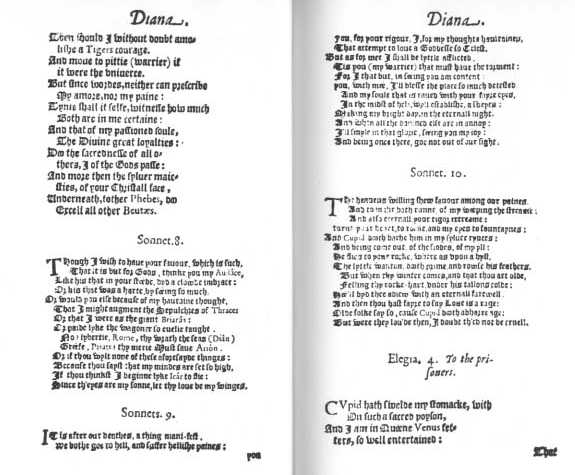
Finally, Sonnet 46 is quoted entire, with the claim that it "smells as potently of the attorney’s office as any of the stanzas penned by Lord Kenyon while an attorney’s clerk in Wales." Hitherto, the legalist case has proceeded on the implicit assumption that Shakespeare chronically vitiates his art by putting in the mouths of lay characters phraseology which only lawyers could understand. Now the implication is that he similarly flavours his sonnets and poems in a way that only a lawyer would have done. Again, all that is necessary is to cast a glance over that contemporary poetry which Lord Campbell never takes into account, This has already been duly done by Sir [88] Sidney Lee; and it will here suffice to quote a few of the sonnets to which he points as the patterns and precedents*** of those in which Shakespeare plays the lawyer: Then to Parthenophe, with all post haste . . . . Why then, inhuman, and my secret
foe, Those Eyes (thy Beauty’s Tenants!)
pay due tears Shall we be told, in the absence of all biographical evidence, that Barnes must have been a lawyer? There is simply no legal trace of him. But what is quite clear is that Shakespeare had read his poems, published in 1593. It is not merely that he writes "legal" sonnets in Barnes’s fashion, and distinctly echoes him at various points:
—the two last recalling Barnes’s
and
but that there are so many echoes of tune and theme that in readin Barnes one seems half the time to be hearing undertones of the more powerful song of Shakespeare. And as Lord Southampton was one of Barnes’s as well as one of Shakespeare’s proclaimed patrons, the two men are very likely to have been acquaintances. Shakespeare’s [90] sonnets are in any case notably in the manner of Barnes’s, and he was following him in legalism as in other fashions. And the same holds of his relation to the anonymous sonneteer who in 1594 published the volume entitled Zepheria. Here we have the same trick of legal phraseology:
and so forth. Two complete "canzons" show how far the fashion went:
It will hardly be disputed that either Shakespeare had read in manuscript, or heard some one quote, Zepheria, or the sonneteer had read Venus and Adonis. That one poet should write of his "heart’s solicitor," and another of the "heart’s attorney," by sheer coincidence, is not plausibly to be argued. And even if it could be proved; which it cannot, that the more lawyerlike poet was a lawyer, it would be sufficiently idle to contend that the other must also have been so, in view of what we have seen of the habit of legalism among all the dramatists of the day. We are witnessing a fashion of the time, comparable with the vogue of Euphuism. The many echoes and parallels of earlier sonnets in those of Shakespeare are weighty hints of the slightness of our ground for taking his as direct records of his heart’s experience. Even when he youthfully imitated other men’s modes, he could not but give to his echoes the deeper vibration of his larger spirit, even as he avoided his models’ grosser crudities. In Zepheria, the canzon last above cited is followed by two in which we have the barbarisms "irrotulate" and "foyalty," "excordiate" and "exordiate"—outrages Possible to a pedant, but not to our poet. But however his finer taste and deeper feeling might preserve him from such offences, he is none the less mannered by the "form and pressure" of the time, which in this matter of legalist vocabulary and imagery is nearly universal. The Elizabethan sonneteers, like the old troubadours, have their tunes and themes in common, and each man’s collection is visibly suggested by or suggestive of others. Their very titles, Phillis, Licia, Delia, Diana, Coelia , IDEA, Zepheria, fidessa, Chloris, Laura, tell of a reigning mode, setting in with Sidney’s Astrophel and [92] Stella, and drawing much on French originals. It was in full force in 1593, and culminated about 1597—the years between which we know Shakespeare to have written many of his "sugred sonnets." That he should copy a particular fashion as he copied the general was entirely natural. Drayton, who was no lawyer, but was a poet, could not so far resist the legalist craze as to abstain from working out in one Sonnet the fancy that his mistress may be tried for murdering his heart"
Shakespeare had thus the example, in these matters, of a poet whom he could not but esteem, and whom in one of his later sonnets he has so closely imitated that there can be no question of the influence. In this case the parallel is so striking that once more we are led to doubt the primary character of the experience suggested in Shakespeare’s sonnet: DRAYTON
Drayton has told in another sonnet (21) how:
and how he did so, with the success desired. It is not easy to believe that these sombre lines of Shakespeare’s were but such an exercise. Yet they may have been. In any case, there is no excuse now left for imputing to an overmastering devotion to law, the result of a deep legal training, the legalisms in which he outwent Drayton. So far from being "lawyerlike" in the sense of striking the literary note natural to a trained lawyer, they struck such a lawyer, to wit Sir John Davies, as rather ridiculous. Davies, in one of his "gulling sonnets," avowedly parodies the legalist sonnets of the poet of Zepheria; and he seems to have had before him in manuscript Shakespeare’s Sonnet 26 when he penned his parody beginning:
"B. Griffin, Gent." who dedicated his Fidessa (1596) to the Gentlemen of the Inns of Court, and was presumably one of them, makes only one slight excursion into legal imagery in his sonnets. Yet the Baconians would have us believe that Bacon, who in his non-legal works so [94] rarely resorts to legal phraseology, touched the sonnets with it so abundantly by reason of a natural professional propensity. In this connection however, it is hardly necessary to consider the theorem which, on the strength of the legalisms and of the fixed Baconian ideal would ascribe to Francis Bacon, as a real expression of experience, all the Sonnets. In no other aspect and over no other issue is that theorem more staggering to judgment. But we shall recur to it in a later chapter. For the present it is enough to have shown how entirely nugatory is the non-comparative process by which Lord Campbell has unwittingly fooled the Baconians to the top of their bent. Citing him, they have relieved themselves of the trouble of outgoing his research. The whole phenomenon is a warning instance of the heedless pretence, and the more heedless acceptance, of authority in criticism. "All law critics admit," says Dr. R. Theobald, that such language as that of the 46th Sonnet "is not the writing of an amateur but of an expert." Lord Campbell alone is cited for the "all": Mr. Devecmon’s counter-doctrine is unknown to the Baconian. We have seen the value of Lord Campbell’s pronouncement, and we shall similarly examine some others. But critics like Dr. Theobald, themselves habitually dogmatising on a basis of literary ignorance, are willingly at the mercy of any false evidence that chimes with their predilection. "Lawyers say," writes Dr. Theobald, "that one of the most difficult things to acquire in their profession is the phraseology." Dr. Theobald need only have read in the Elizabethan drama a little further than he went for material to prove that Bacon wrote Shakespeare and Marlowe, in order to learn that the lawyers talked ignorantly. When, however, he proceeds to help them in their mystification by asserting that "the outsider is sure, sooner or later, to be found out. He will traverse what he approves (!)—or empanel a witness (!) instead of a jury—or in some way his legal chatter will degenerate into jargon." On this principle, Dr. Theobald’s assent to the lawyer’s claim is of no value; he being no lawyer. Unable to illustrate his proposition save by imaginary enormities of blundering, he must by his own account be unable to detect any slighter deviations from legal accuracy. Then his endorsement of their expertise is admittedly worthless to start with. Lawyers of literary competence will be the first to admit, on a study of the case, that Lord Campbell’s handling of the literary problem before us partakes of the nature of literary charlatanism and that Lord Penzance’s professed "summing-up of the Bacon-Shakespeare problem, being a grossly ex parte statement, is entitled to neither lay nor professional respect. In this matter the sole authorities are critical reason and literary evidence. Unhappily we shall find some professed Shakespearean scholars as uncritical as the judges. __________ * This term occurs only once in Shakespeare. back ** This term never occurs in Shakespeare. back *** Before the fashion of sonnets broke out as it did in the 'nineties, George Gascoigne had produced his poem "The Arraign-ment of a Lover" (in Posies, 1575), wherein the lover is tried at "Beauty's Bar," accused by False Suspect, whereon "Craft, the Crier, called a Quest," and after sentence "Jealous, the Jailor, bound we fast, To hear the verdict of the Bill"; the procedure ending with "Faith and Truth my Sureties," than which there is "no better warrantise." See the poem in Arber's Spenser Anthology, p. 132; Gascoigne's Works, ed. Cunliffe, i, 38. back Dr. Creighton, in his Shakespeare's Story of his Life (1904), works out a wildly speculative tale of Shakespeare's use of Barnes as "devil" after lampooning him as Parolles. All this is idle myth-mongering; but the two men must have met. back No. 51 of ed. 1599 of Idea; No. 2 in reprint in Elizabethan Sonnets, as cited, ii, 182. back Shakespeare Studies in Baconian Light, 1904, p. 19. back |
Copyright © 2000 by Mark Alexander.
All Rights Reserved. SOURCETEXT, SHARETEXT,
SOURCETEXT.COM, SHARETEXT.COM, THE
SHAKESPEARE AUTHORSHIP SOURCEBOOK,
THE SHAKESPEARE LAW LIBRARY, THE
HU PAGE, THE
SCHOOL OF PYTHAGORAS
and others are trademarked 1997, 1998, 1999, and 2000 by
Mark Alexander, P. O. Box 620008, Woodside, CA 94062-0008.
SourceText.Com and ShareText.Com are
divisions of
Breeze Productions, P.O. Box 620008, Woodside, CA 94062-0008.